Designer’s Diary · Public Playtest
Ranks of Steel at Victorius: What We Learned from Our First Public Playtest
Our first day putting Ranks of Steel in front of the wargaming public reinforced the game’s design philosophy, challenged a few assumptions, changed some rules and introduced a lot more people to the battlefield.
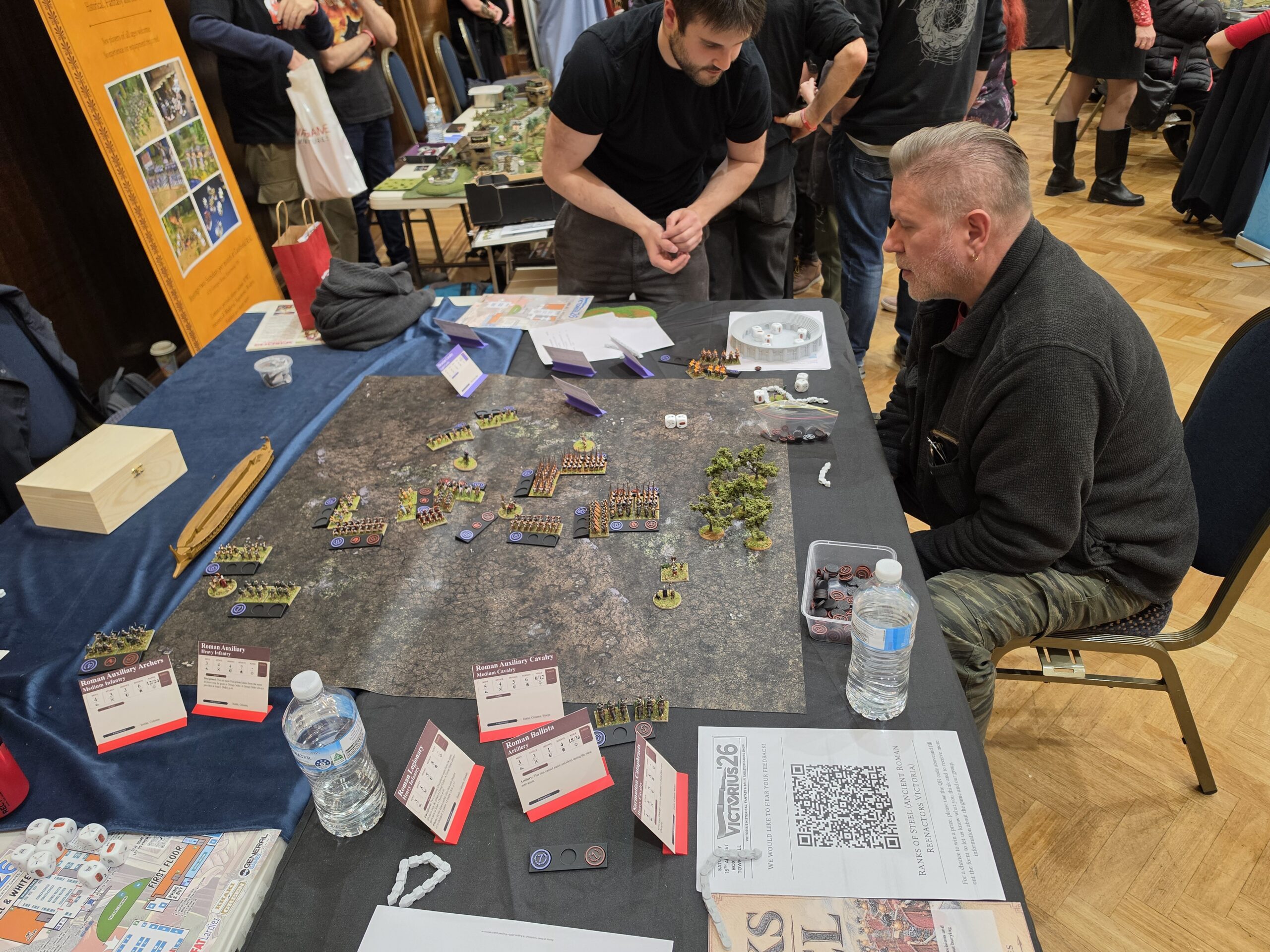
This weekend, Ranks of Steel had its first real opportunity to meet the wargaming public at Victorius ’26.
Rather than running a series of formally scheduled games, we kept a battle running throughout the day. People could stop by, watch what was happening, ask questions about the rules and, most importantly, see how Ranks of Steel actually works on the tabletop.
For a game still in development, it was an invaluable experience.
Design Philosophy
Fast Play, Not Simple
One of the central ideas behind Ranks of Steel has always been to strip away unnecessary complexity while retaining the decisions that make a historical battle interesting.
At Victorius, one visitor suggested that I should stop describing the game as simple and instead describe it as fast play.
They were right.
Ranks of Steel isn’t intended to remove tactical decisions. It is intended to remove the processes that get between the player and those decisions.
Movement is a good example.
Instead of rulers, turning radii and complicated manoeuvre rules, Ranks of Steel uses movement chains. Place the chain, move the unit along it, and the natural flexibility of the chain allows formations to turn and manoeuvre without stopping the game to calculate angles.
The movement chains attracted quite a bit of attention during the day. They are tactile, immediately understandable and, most importantly, keep units moving.
The same was true of the game’s custom Combat Dice. Attack and defence are resolved through opposed dice pools, with the symbols on the dice making the result quickly readable on the table.
Neither system exists simply to make the game easier. They exist to make it faster to get from decision to consequence.
That distinction is increasingly important to how I think about Ranks of Steel.
“The aim isn’t to remove tactical decisions. It’s to remove the processes that get between the player and those decisions.”Ranks of Steel design philosophy
Learning the Game
Five Minutes to Understand the Basics
Perhaps the most encouraging demonstration of this came from a friend who had come along to support the playtest.
He had no previous knowledge of Ranks of Steel.
After about five minutes of explanation, he understood enough of the basic system to sit down and play a complete game with a member of the public.
That was an important moment.
Throughout the day, experienced wargamers and people with much less experience stopped at the table, and most seemed to grasp what was happening remarkably quickly.
That’s exactly what I want from the system.
I don’t want the first hour of a game to be spent teaching someone how to play it. I want to explain the fundamentals, put units on the battlefield and allow the rules to become apparent through play.
The complexity should come from what you decide to do, rather than remembering how you’re allowed to do it.
Decision Before Procedure
The Rules Need to Get Out of the Way
That philosophy shaped many of the conversations during the day.
Movement chains and Combat Dice were obvious talking points because they are visually distinctive, but the broader discussion repeatedly came back to the relative lack of procedural complexity.
A player should be thinking:
Do I commit the cavalry now?
Can the phalanx hold that position?
Do I advance or wait for support?
Can I break this formation before its reinforcements arrive?
They shouldn’t be thinking:
Which page tells me whether I’m allowed to turn 37 degrees while moving?
Historical wargaming inevitably involves abstraction. The important question isn’t whether something has been abstracted, but whether the abstraction produces interesting decisions and plausible consequences.
Victorius gave us our first opportunity to see whether those abstractions made sense to people who hadn’t been involved in designing them.
For the most part, they did.
Rules Development
And Then the Archers Started Shooting…
Of course, a playtest that doesn’t change anything isn’t doing its job.
One area that came under particular scrutiny was missile troops — especially what happens when archers fire into a combat in which friendly troops are already engaged.
The rule has now changed.
Archers can fire at enemy formations engaged in melee but doing so carries a risk. A sufficiently poor result can cause damage to the friendly formation involved in that combat.
That creates a much more interesting decision.
You can order the archers to loose into the swirling mass of troops.
The question is whether you should.
This is exactly the kind of rule I want Ranks of Steel to produce: easy to explain, quick to resolve, but with a meaningful tactical decision attached to it.
There will undoubtedly be more changes as testing continues.
That’s the point.
Beyond the Rules
The Biggest Result Wasn’t a Rules Change
Perhaps the most encouraging outcome from Victorius was simply the level of interest.
A steady stream of people stopped to look at the game, talk about its design and ask about further playtesting.
By the end of the day, a significant number of people had expressed an interest in participating in future playtesting .
For a game at this stage of development, that’s enormously valuable.
The next phase of Ranks of Steel needs to happen on tables I don’t control.
I know how the rules are supposed to work. What matters now is what happens when someone downloads them, puts two armies on a table and plays without the designer standing beside them.
Where do they hesitate?
What do they misunderstand?
What tactics emerge that I hadn’t anticipated?
What gets ignored?
Is it fun enough that they want to play again?
The next phase of Ranks of Steel needs to happen on tables I don’t control.
The Road Ahead
What Comes Next
Victorius reinforced something I’ve increasingly come to believe about Ranks of Steel.
This should be a game that is easy to get onto the table.
Not a starter version. Not a cut-down edition. The full game.
Players who want a physical rulebook, campaign books, professionally produced cards and other premium material will eventually be able to buy them. But access to the core game itself shouldn’t be the barrier.
We’re also developing the historical side of Ranks of Steel. Unit cards will eventually include QR codes connecting players to additional information about the troops represented on the tabletop — historical discussion, primary sources, imagery and further reading.
The idea is increasingly simple:
Play the battle.
Discover the history.
Victorius was the first opportunity to see how Ranks of Steel worked outside the environment in which it was created.
We came away with changes to make, plenty to think about, and — most importantly — considerably more people wanting to play the game.
That’s a pretty good result for a first public outing.
Help Shape the Game
Join the Ranks
Ranks of Steel is still being developed, and we’re looking for players and gaming clubs interested in helping test it.
If you’d like to receive playtest material, new unit cards, scenarios, development updates and notification when the complete free rules become available, join the Ranks of Steel mailing list below.
The rules are free.
The battlefield is yours.